- +91 7680015156
- advaithacdc@gmail.com
7 Essential Motor Skills needed for a Child to Reach Academic Success
- Home
- Blogs
- 7 Essential Motor Skills needed for a Child to Reach Academic Success
Academic success is not only about reading books, learning numbers, or memorizing information. Before children can comfortably write, read, concentrate, participate in classroom activities, and complete schoolwork, they need a strong foundation of physical and motor skills.
Motor development influences how a child sits in a classroom, holds a pencil, uses scissors, follows instructions, moves between activities, and interacts with classmates. When these foundational skills develop appropriately, children may find it easier to participate confidently in learning activities.
At Advaitha Child Development Center, we understand that every child develops at an individual pace. Families looking for the Best Child Development Center in Vijayawada can benefit from understanding the important connection between motor development and a child's everyday learning abilities.
Why Are Motor Skills Important for Academic Success?
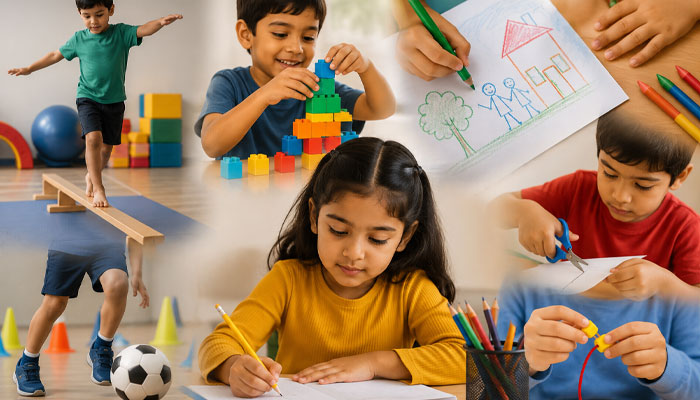
Motor skills are the abilities that allow children to control and coordinate their body movements. They include large movements such as running and jumping, as well as smaller and more precise movements such as holding a pencil, turning pages, buttoning clothes, and manipulating classroom materials.
In school, children constantly use motor skills without even realizing it. Sitting upright, looking at the board, copying information, writing, colouring, cutting paper, carrying a school bag, participating in games, and organizing books all require different levels of motor control.
Here are seven important motor skills that can contribute to a child's academic participation and overall development.
1. Fine Motor Skills
Fine motor skills involve controlled movements of the small muscles in the hands, fingers, and wrists. These skills are especially important during the early school years.
Children use fine motor skills for holding pencils and crayons, writing letters and numbers, drawing, colouring, using scissors, opening lunch boxes, turning pages, and handling small learning materials.
Activities such as playing with building blocks, threading beads, using play dough, completing puzzles, tearing and pasting paper, and picking up small objects can provide opportunities to practise hand and finger movements.
Well-developed fine motor abilities can help make classroom tasks more manageable and allow children to focus more attention on learning rather than struggling with the physical demands of an activity.
2. Gross Motor Skills
Gross motor skills involve larger muscle groups in the arms, legs, shoulders, and trunk. Running, jumping, climbing, throwing, catching, and maintaining posture are common examples.
Although these abilities may appear unrelated to academics, gross motor development provides an important physical foundation for classroom participation. A child needs adequate body strength and stability to sit comfortably at a desk, maintain posture, participate in physical education, and move safely around the school environment.
Outdoor play, obstacle courses, jumping activities, ball games, climbing, and age-appropriate movement activities can help children practise gross motor abilities in an enjoyable way.
3. Core Strength and Postural Control
Core strength refers to the stability provided by the muscles around the abdomen, back, pelvis, and trunk. Good postural control helps a child maintain an appropriate sitting or standing position while performing different activities.
Imagine trying to write while constantly adjusting your body to remain upright. For some children, insufficient postural stability can make desk-based activities more tiring. They may lean heavily on the table, frequently change position, or find prolonged seated activities difficult.
Activities involving crawling, climbing, balancing, animal walks, supervised floor play, and other movement-based tasks can provide opportunities to develop core strength and body stability.
4. Bilateral Coordination
Bilateral coordination is the ability to use both sides of the body together in a coordinated manner. Many everyday school activities require one hand to perform an action while the other hand provides support.
For example, a child may hold a sheet of paper with one hand while writing with the other. Cutting with scissors requires one hand to operate the scissors while the other moves the paper. Opening a container, tying shoelaces, using a ruler, and participating in sports also require bilateral coordination.
Clapping games, catching balls, threading activities, tearing paper, rolling dough, cycling, and activities that require both hands can help children practise coordinated movements.
5. Hand-Eye Coordination
Hand-eye coordination allows visual information to guide hand movements. It is an important skill for many classroom tasks.
Children rely on hand-eye coordination when copying from a board, tracing shapes, writing within lines, completing puzzles, colouring, catching a ball, arranging blocks, and placing objects accurately.
Simple activities such as throwing and catching balls, building with blocks, completing mazes, joining dots, puzzles, drawing, and sorting objects can provide useful practice for visual and hand coordination.
6. Motor Planning
Motor planning is the ability to think about, organize, and carry out a movement or sequence of movements. It helps children understand what their body needs to do when performing a new or multi-step activity.
In a classroom, motor planning may be involved when a child has to take a notebook from a bag, open it to the correct page, pick up a pencil, copy information, and then put the materials away. It is also used during playground activities, sports, dressing, crafts, and everyday routines.
Obstacle courses, action songs, imitation games, construction activities, and movement sequences can encourage children to practise planning and completing actions in an organized manner.
7. Visual-Motor Integration
Visual-motor integration is the ability to coordinate what the eyes see with how the body, particularly the hands, responds. It plays an important role in handwriting and many early academic activities.
Children use visual-motor integration when copying letters, numbers, shapes, and patterns. It is also needed for drawing, colouring within boundaries, arranging objects according to a model, and completing worksheets.
Activities such as tracing, copying simple patterns, puzzles, block designs, matching games, drawing shapes, and age-appropriate construction tasks can help children practise integrating visual information with physical movement.
Motor Development and Classroom Confidence
When everyday classroom tasks require significant physical effort, a child may become frustrated, avoid certain activities, or need additional time to complete them. Supporting foundational motor development can make participation in learning, play, self-care, and social activities more comfortable.
It is also important to remember that children develop differently. Difficulty with one motor skill does not automatically indicate a developmental disorder. However, if parents or teachers consistently notice challenges with handwriting, balance, coordination, sitting posture, using classroom tools, dressing, or participating in age-appropriate physical activities, discussing these observations with a qualified child development professional can be helpful.
How Parents Can Encourage Motor Development at Home
Motor development does not always require complicated equipment. Everyday play can provide valuable opportunities for children to move, explore, and practise new abilities.
- Encourage outdoor play such as running, jumping, and climbing.
- Provide puzzles, blocks, crayons, and age-appropriate craft materials.
- Use play dough to encourage hand and finger movements.
- Play simple throwing, catching, and rolling ball games.
- Encourage drawing, colouring, tracing, and paper-based activities.
- Include supervised obstacle courses and balancing games.
- Allow children to practise age-appropriate self-care activities independently.
The goal is not to make every activity feel like training. Children often develop important abilities naturally when they are given regular opportunities for active, meaningful, and enjoyable play.
Advaitha Child Development Center – Supporting Your Child's Development
Every child's developmental journey is unique. Understanding a child's individual strengths and areas where additional support may be useful can help families make informed decisions about their development.
Advaitha Child Development Center focuses on supporting children through developmentally appropriate approaches designed around their individual needs. For parents searching for the Best Child Development Center in Vijayawada, choosing a center that considers motor, communication, sensory, social, and functional development together can be an important step.
Motor abilities such as fine motor control, gross motor coordination, core stability, bilateral coordination, hand-eye coordination, motor planning, and visual-motor integration can all contribute to a child's ability to participate effectively in school and everyday life.
Building Strong Foundations for Future Learning
Academic learning begins with much more than books and worksheets. A child who can comfortably control their body, coordinate their hands and eyes, plan movements, and use classroom tools has important foundational skills for participating in educational activities.
Rather than focusing only on academic performance, parents and educators can support the whole child by providing opportunities for movement, exploration, play, communication, and independence.
If you have concerns about your child's motor development or classroom participation, seeking an appropriate developmental assessment can help identify their individual strengths and support needs. Advaitha Child Development Center is committed to helping children build meaningful developmental foundations that can support learning, independence, participation, and confidence.
For families seeking the Best Child Development Center in Vijayawada, Advaitha Child Development Center provides child-focused developmental support with the goal of helping every child progress toward their individual potential.
Articles
- Auditory Processing Delays when Primitive Reflexes are Retained
- Aren’t Retained Primitive Reflexes Just Autistic Disorders?
- Retained Primitive Reflexes Creating Self-Esteem Issues and Self-Doubt in Kids
- Stop Using White Noise to put Babies and Toddlers to Sleep? What the Research Says
- Attention Activities Building Foundational Elements for Attention and Focus and ADHD
- 10 Brain Boosting Activities to Awaken the Brain for Learning Readiness
- In-Home Circle Time Schedule with Purposeful Movement for Therapists, Parents and Teachers
- Home-Based Circle Time Movement and Brain Break Resources for Parents and Therapists
- In-Home Movement Activities and Brain Breaks from the Best Occupational Therapists
- Gross motor skills tied to child’s brain development
- Wrapped Legs Around Chair? A Sign of Weak Core Muscle that Causes Reading and Writing Delays
- CUP STACKING: Studies Show Cup Stacking Improves Reading Test Scores and Cross-Patterning
- Jumping Toys for better Vestibular Input
- Why handwriting fails without proper Core Strength and Hand Strength
- 7 Essential Motor Skills needed for a Child to Reach Academic Success
- Are delayed milestones and weak motor skills causing gaps in my child’s learning
- The 4 Foundational Cornerstones needed to develop a Child’s Learning Readiness
- anchor-sight-word-retention-with-simple-movement-exercises
- Brain-Building Animal Movement Activities Target Learning Skills
- 7 Strategies to Accomplish Positive Compliance with Retained Primitive Reflex Integration
- Child with Zinc Deficiency may show signs of Learning Challenges
- Hands-Grasping Reflex Delays Handwriting and Speech Development if Retained
- Deep Breathing Activities to Calm Sensory Meltdowns and Ground Emotions
- 3 Retained Primitive Reflexes Responsible for Poor Balance
- toe walking
- Anxious Behavior
- Retained Primitive Reflexes that Cause Sensory Sensitivities
- Retained Primitive Reflexes Causing Picky Eating, Sugar Cravings and Compulsive Eating
- Tactile Defensiveness
- 10 Fun Activities to Boost Your Child's Speech Development
- Exploring Learning through Play: Educational Activities for Kids
- Why Crossing the Midline Activities Helped this Childrens Listen to his Teacher
- Music Therapy: Study Says Music Key for Non-Verbal Children and Children with Speech and Language Delays
- Tactile Toys for Sensory Defensiveness and Tactile Stimulation
Have any Query or Need any information about our services
