
- +91 7680015156
- advaithacdc@gmail.com
Stop Using White Noise to put Babies and Toddlers to Sleep? What the Research Says
- Home
- Blogs
- Stop Using White Noise to put Babies and Toddlers to Sleep? What the Research Says
White noise has become a familiar part of bedtime in many homes. Parents often use sound machines, fans, or white-noise apps to mask household sounds and help babies or toddlers settle down. But growing discussion around noise exposure has raised an important question: should parents stop using white noise altogether?
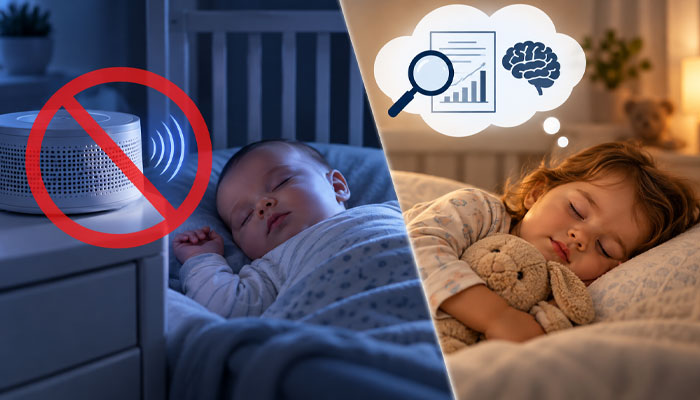
The research does not support a simple “white noise is bad” conclusion. Instead, the bigger concern is how loud it is, how close the sound source is to the child, and how long the child is exposed to it.
Why Does White Noise Help Some Babies Sleep?
White noise creates a steady background sound that can make sudden environmental noises less noticeable. Doors closing, traffic, conversations, television sounds, or siblings playing may be less disruptive when a consistent background sound is present.
Some research suggests that white noise can help certain newborns fall asleep more quickly. In a small randomized study involving 40 newborns, 80% of babies exposed to white noise fell asleep within five minutes, compared with 25% in the control group.
However, helping a baby fall asleep quickly does not automatically mean that continuous white-noise exposure throughout every nap and night is necessary or risk-free.
So, Why Are Experts Concerned?
The primary concern is not the existence of background sound itself. It is excessive sound exposure.
Some commercially available sleep machines are capable of producing surprisingly high sound levels. Research testing infant sleep machines found that certain devices, particularly when used at maximum volume and close to an infant, could produce sound levels high enough to raise concerns about prolonged exposure.
Babies have developing auditory systems, and they may spend many hours sleeping each day. This makes both the intensity and duration of sound exposure important considerations.
Does White Noise Damage a Baby's Hearing?
It would be inaccurate to say that normal use of every white-noise machine causes hearing damage. The available evidence does not establish that appropriately used white noise inevitably harms children's hearing.
What researchers have demonstrated is that some devices are capable of producing potentially hazardous sound levels when used incorrectly. For example, studies have found that certain machines and apps can exceed recommended noise-exposure thresholds when operated at high volume close to a child's head.
This distinction matters. A softly playing machine located across the room is very different from a device playing at maximum volume beside a baby's crib.
What About Speech, Language and Brain Development?
This area is still being investigated.
A review of research into continuous white-noise exposure during sleep highlighted concerns about possible effects on hearing, speech, and learning when exposure is excessive or inappropriate. However, researchers also noted limitations in the available evidence, including the difficulty of translating findings from animal studies directly to human children.
Therefore, parents should be cautious about dramatic claims that white noise definitely causes developmental delays. Current evidence supports responsible use and avoiding unnecessary prolonged or loud exposure rather than assuming every form of white noise is harmful.
Should Parents Stop Using White Noise Completely?
For most families, the practical message is not necessarily “throw away the sound machine.” Instead, consider whether it is being used safely and whether your child actually needs it.
The American Academy of Pediatrics advises that if infant sleep machines are used, it may be safer to keep them as far away from the infant as possible, use the lowest effective volume, and limit how long they operate.
A timer can be useful if white noise is primarily needed while the child is settling. Once the baby or toddler is asleep, continuous sound may not always be necessary.
Safer Ways to Use White Noise
- Keep the device away from the crib: Avoid placing a sound machine inside the crib, attached to the crib rail, or immediately beside your child's head.
- Turn the volume down: Louder does not necessarily mean better sleep. Use the lowest volume that effectively masks disruptive environmental sounds.
- Avoid maximum-volume settings: Research has shown that some devices can reach potentially hazardous sound levels at their highest settings.
- Consider limiting duration: Instead of automatically running white noise throughout the entire night, consider using a timer or switching it off after your child settles.
- Do not try to overpower a noisy environment: If the room itself is extremely noisy, reducing the original source of noise may be preferable to making the sound machine progressively louder.
- Reassess as your child grows: A sleep aid that was useful during infancy does not necessarily need to become a permanent part of childhood sleep.
Can Babies Become Dependent on White Noise?
White noise can become part of a child's sleep association. If it is present every time a child falls asleep, the child may begin to associate that sound with bedtime.
That does not necessarily mean the child has developed a harmful “addiction.” However, parents who prefer greater flexibility may gradually reduce reliance on it.
For example, the volume can be slowly lowered over several nights, the machine can be turned off earlier, or it can be reserved for particularly noisy situations.
What Can You Use Instead?
White noise is only one possible part of a bedtime routine. Babies and toddlers often benefit from predictable sleep cues such as dimming the lights, maintaining an age-appropriate bedtime, reading a short book, singing quietly, and keeping the sleeping environment calm and comfortable.
For babies, these routines should always be combined with established safe-sleep practices. White noise should never replace attention to the child's sleeping position, sleep surface, or other safety recommendations.
The Bottom Line
Parents do not necessarily need to stop using white noise, but they should avoid assuming that more volume or longer exposure is better.
Research suggests that white noise may help some babies settle and fall asleep. At the same time, studies show that some sleep machines can produce potentially unsafe sound levels when placed too close to a baby or operated at high volume for prolonged periods.
The sensible approach is moderation: keep the sound machine away from the child, use a low volume, consider limiting the duration, and avoid unnecessary continuous exposure.
If a baby or toddler has persistent sleep difficulties, frequent waking, unusual responses to sound, concerns about hearing, or developmental concerns, parents should discuss them with a pediatrician rather than relying solely on a sound machine to solve the problem.
Frequently Asked Questions
Is white noise safe for babies?
White noise may be used cautiously, but volume, distance, and duration matter. Avoid placing the device close to the baby's head or playing it loudly for prolonged periods.
Should white noise stay on all night?
It may not be necessary. If white noise is mainly being used to help a child settle, parents can consider a timer or turning it off once the child is asleep.
How close should a white-noise machine be to a baby?
Keep the device well away from the baby's sleeping area rather than placing it inside or directly beside the crib. Greater distance generally reduces the sound level reaching the child's ears.
Can loud white noise affect hearing?
Potentially. Research has demonstrated that some infant sleep machines can generate high sound levels, especially at maximum volume and when positioned close to the child.
Is white noise necessary for good sleep?
No. Some children find it helpful, while others sleep well without it. A consistent bedtime routine and an appropriate sleeping environment are more fundamental components of healthy sleep habits.
Articles
- Auditory Processing Delays when Primitive Reflexes are Retained
- Aren’t Retained Primitive Reflexes Just Autistic Disorders?
- Retained Primitive Reflexes Creating Self-Esteem Issues and Self-Doubt in Kids
- Stop Using White Noise to put Babies and Toddlers to Sleep? What the Research Says
- Attention Activities Building Foundational Elements for Attention and Focus and ADHD
- 10 Brain Boosting Activities to Awaken the Brain for Learning Readiness
- In-Home Circle Time Schedule with Purposeful Movement for Therapists, Parents and Teachers
- Home-Based Circle Time Movement and Brain Break Resources for Parents and Therapists
- In-Home Movement Activities and Brain Breaks from the Best Occupational Therapists
- Gross motor skills tied to child’s brain development
- Wrapped Legs Around Chair? A Sign of Weak Core Muscle that Causes Reading and Writing Delays
- CUP STACKING: Studies Show Cup Stacking Improves Reading Test Scores and Cross-Patterning
- Jumping Toys for better Vestibular Input
- Why handwriting fails without proper Core Strength and Hand Strength
- 7 Essential Motor Skills needed for a Child to Reach Academic Success
- Are delayed milestones and weak motor skills causing gaps in my child’s learning
- The 4 Foundational Cornerstones needed to develop a Child’s Learning Readiness
- anchor-sight-word-retention-with-simple-movement-exercises
- Brain-Building Animal Movement Activities Target Learning Skills
- 7 Strategies to Accomplish Positive Compliance with Retained Primitive Reflex Integration
- Child with Zinc Deficiency may show signs of Learning Challenges
- Hands-Grasping Reflex Delays Handwriting and Speech Development if Retained
- Deep Breathing Activities to Calm Sensory Meltdowns and Ground Emotions
- 3 Retained Primitive Reflexes Responsible for Poor Balance
- toe walking
- Anxious Behavior
- Retained Primitive Reflexes that Cause Sensory Sensitivities
- Retained Primitive Reflexes Causing Picky Eating, Sugar Cravings and Compulsive Eating
- Tactile Defensiveness
- 10 Fun Activities to Boost Your Child's Speech Development
- Exploring Learning through Play: Educational Activities for Kids
- Why Crossing the Midline Activities Helped this Childrens Listen to his Teacher
- Music Therapy: Study Says Music Key for Non-Verbal Children and Children with Speech and Language Delays
- Tactile Toys for Sensory Defensiveness and Tactile Stimulation
Have any Query or Need any information about our services
