- +91 7680015156
- advaithacdc@gmail.com
Gross motor skills tied to child’s brain development
- Home
- Blogs
- Gross motor skills tied to child’s brain development
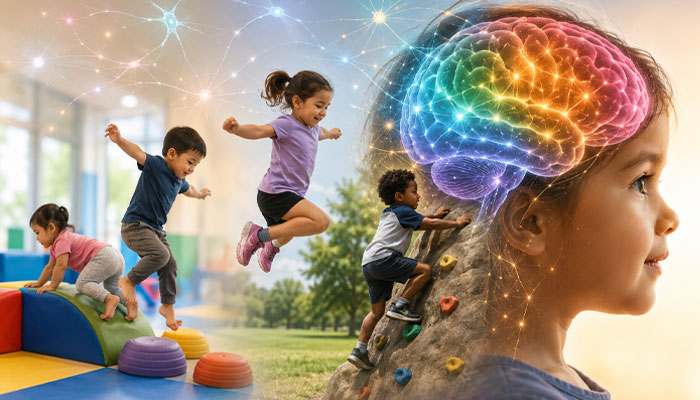
Child development is a remarkable process in which the brain and body grow together. From a baby learning to roll over to a preschooler running, jumping, climbing, and balancing, every physical movement supports much more than muscle strength. Gross motor skills are closely connected to a child’s brain development, helping build coordination, attention, confidence, spatial awareness, learning abilities, and independence.
Gross motor skills involve the large muscles of the body, including those in the arms, legs, shoulders, back, and core. These skills allow children to perform everyday movements such as sitting, standing, walking, running, jumping, throwing, catching, climbing, and maintaining balance. While these activities may appear to be mainly physical, they require continuous communication between the brain, muscles, nerves, and sensory systems.
What Are Gross Motor Skills?
Gross motor skills are movements that involve large muscle groups and whole-body coordination. They begin developing from infancy and continue improving throughout childhood. Early milestones such as head control, rolling, sitting, crawling, standing, and walking create the foundation for more advanced movements later in life.
As children grow, their gross motor abilities become more complex. They learn to run with better control, climb stairs, kick and catch a ball, ride a bicycle, hop on one foot, participate in sports, and navigate different environments safely. Each new movement requires the brain to process information, plan an action, coordinate the muscles, maintain balance, and adjust the movement when necessary.
How Gross Motor Activity Supports Brain Development
The developing brain forms and strengthens neural connections through experience. Physical activity provides rich sensory and movement experiences that stimulate several areas of the brain at the same time. When a child crawls through a tunnel, climbs playground equipment, balances on a beam, or catches a ball, the brain is constantly receiving and interpreting information.
Movement can support communication between areas responsible for balance, coordination, attention, sensory processing, memory, and motor planning. Repeated practice helps these pathways become more efficient. This is one reason active play is such an important part of healthy childhood development.
Movement Encourages Motor Planning
Motor planning is the brain’s ability to think about, organize, and carry out a physical action. For example, when a child wants to climb onto a chair, the brain must judge the chair’s height, decide where to place the hands and feet, coordinate the body, and maintain balance.
Activities such as obstacle courses, climbing, jumping between markers, throwing balls into targets, and navigating playground equipment encourage children to plan movements and solve physical problems. These experiences may also support broader skills such as sequencing, problem-solving, persistence, and decision-making.
Balance and Coordination Develop Through Brain-Body Communication
Balance depends on several systems working together, including vision, muscles, joints, the inner ear, and the brain. The brain combines information from these systems to help children understand where their body is positioned and how to remain stable while moving.
Simple activities such as walking along a line, standing on one foot, jumping, swinging, climbing, or riding a bicycle can challenge balance and coordination. Regular opportunities to practice these movements help children gain better control over their bodies and become more confident in everyday activities.
Gross Motor Skills Can Support Attention and Learning
Physical movement can help children become more alert and ready to participate in learning activities. Active play gives children opportunities to release energy, explore their environment, and engage their senses. After appropriate physical activity, some children may find it easier to sit, listen, participate, and concentrate during classroom or home-based learning.
Movement-based learning can also make educational activities more engaging. Counting while jumping, identifying colours during a running game, following movement instructions, or acting out stories allows children to combine physical experiences with language and thinking skills.
Cross-Body Movements and Coordination
Cross-body or cross-lateral movements occur when one side of the body works across the centre line toward the opposite side. Examples include touching the right hand to the left knee, crawling, reaching across the body, marching with opposite arm and leg movements, or throwing across the body.
These movements require coordinated control of both sides of the body. They can help children develop bilateral coordination and body awareness, which are useful for many everyday tasks. Activities involving both sides of the body may also prepare children for classroom tasks that require coordinated eye, hand, and body movements.
Strong Core Muscles Support Classroom Skills
Core strength is an important part of gross motor development. The muscles around the abdomen, back, shoulders, and pelvis help children maintain a stable posture while sitting, standing, reaching, writing, and playing.
A child with good postural stability can use the hands more efficiently because the body has a strong base of support. Activities such as climbing, crawling, animal walks, swimming, playground play, yoga poses, and supervised balance exercises can help develop core strength naturally.
Gross Motor Play Builds Confidence and Independence
Physical skills influence how children participate in everyday life. A child who feels confident walking, running, climbing, or playing with a ball may be more willing to join games with other children, explore new environments, and try unfamiliar activities.
Every successfully achieved movement can create a sense of accomplishment. Learning to jump independently, climb a step, ride a bicycle, or catch a ball shows children that practice can lead to improvement. This can encourage persistence and confidence when they face other developmental challenges.
Simple Gross Motor Activities for Children
Children do not always need specialised equipment to develop gross motor skills. Many helpful activities can be included in everyday play. Parents and caregivers can encourage running, jumping, hopping, crawling, dancing, throwing and catching soft balls, climbing age-appropriate playground structures, walking on marked lines, playing simple obstacle courses, and participating in action songs.
Outdoor play is especially valuable because it gives children space to move freely and experience different surfaces, directions, speeds, and physical challenges. Indoor activities can also be adapted safely using cushions, tunnels, floor markers, soft balls, and movement games.
Every Child Develops at Their Own Pace
Children develop gross motor abilities at different rates. Some children may begin walking, climbing, or catching a ball earlier than others. Small differences can be completely normal. What matters most is whether the child continues making progress and has regular opportunities to move, explore, and practice new skills.
However, parents may notice signs such as frequent falling, difficulty maintaining balance, avoiding physical play, difficulty running or jumping compared with similarly aged children, unusual stiffness or weakness, trouble climbing stairs, or significant difficulty coordinating both sides of the body. When concerns persist, discussing them with a pediatrician, physiotherapist, occupational therapist, or child development professional can help determine whether further assessment is needed.
Supporting the Brain Through Active Play
Gross motor development is much more than learning how to move. Every climb, jump, crawl, throw, and balance activity gives the developing brain valuable information about the body and the surrounding world. Through repeated movement experiences, children can strengthen coordination, motor planning, balance, body awareness, attention, confidence, and independence.
Parents, teachers, and caregivers can support healthy development by giving children safe, age-appropriate opportunities for active play every day. Rather than focusing only on structured exercises, encourage children to explore movement naturally through games, playground activities, dancing, outdoor play, and everyday physical challenges.
Conclusion
Gross motor skills and brain development are deeply connected. Movement helps children learn how to control their bodies while supporting important neurological processes involved in coordination, sensory processing, attention, planning, and learning. Providing regular opportunities for active play can therefore contribute to a child’s overall physical, cognitive, social, and emotional development.
When children move, they are not simply exercising their muscles—they are also giving their growing brains opportunities to learn, adapt, connect, and develop.
Articles
- Auditory Processing Delays when Primitive Reflexes are Retained
- Aren’t Retained Primitive Reflexes Just Autistic Disorders?
- Retained Primitive Reflexes Creating Self-Esteem Issues and Self-Doubt in Kids
- Stop Using White Noise to put Babies and Toddlers to Sleep? What the Research Says
- Attention Activities Building Foundational Elements for Attention and Focus and ADHD
- 10 Brain Boosting Activities to Awaken the Brain for Learning Readiness
- In-Home Circle Time Schedule with Purposeful Movement for Therapists, Parents and Teachers
- Home-Based Circle Time Movement and Brain Break Resources for Parents and Therapists
- In-Home Movement Activities and Brain Breaks from the Best Occupational Therapists
- Gross motor skills tied to child’s brain development
- Wrapped Legs Around Chair? A Sign of Weak Core Muscle that Causes Reading and Writing Delays
- CUP STACKING: Studies Show Cup Stacking Improves Reading Test Scores and Cross-Patterning
- Jumping Toys for better Vestibular Input
- Why handwriting fails without proper Core Strength and Hand Strength
- 7 Essential Motor Skills needed for a Child to Reach Academic Success
- Are delayed milestones and weak motor skills causing gaps in my child’s learning
- The 4 Foundational Cornerstones needed to develop a Child’s Learning Readiness
- anchor-sight-word-retention-with-simple-movement-exercises
- Brain-Building Animal Movement Activities Target Learning Skills
- 7 Strategies to Accomplish Positive Compliance with Retained Primitive Reflex Integration
- Child with Zinc Deficiency may show signs of Learning Challenges
- Hands-Grasping Reflex Delays Handwriting and Speech Development if Retained
- Deep Breathing Activities to Calm Sensory Meltdowns and Ground Emotions
- 3 Retained Primitive Reflexes Responsible for Poor Balance
- toe walking
- Anxious Behavior
- Retained Primitive Reflexes that Cause Sensory Sensitivities
- Retained Primitive Reflexes Causing Picky Eating, Sugar Cravings and Compulsive Eating
- Tactile Defensiveness
- 10 Fun Activities to Boost Your Child's Speech Development
- Exploring Learning through Play: Educational Activities for Kids
- Why Crossing the Midline Activities Helped this Childrens Listen to his Teacher
- Music Therapy: Study Says Music Key for Non-Verbal Children and Children with Speech and Language Delays
- Tactile Toys for Sensory Defensiveness and Tactile Stimulation
Have any Query or Need any information about our services
