
- +91 7680015156
- advaithacdc@gmail.com
Are delayed milestones and weak motor skills causing gaps in my child’s learning
- Home
- Blogs
- Are delayed milestones and weak motor skills causing gaps in my child’s learning
Every child grows, learns, and develops at their own pace. Some children start walking early, while others may take a little longer. Some begin speaking quickly, while others need additional support to develop communication skills. Small variations can be part of normal development, but when developmental milestones are consistently delayed or motor skills remain weak, these challenges may sometimes affect a child’s learning and participation in everyday activities.
Parents may notice that their child struggles to sit properly during learning activities, hold a pencil, follow instructions, communicate needs, play with other children, climb stairs, maintain balance, or complete age-appropriate tasks. These difficulties may be connected to underlying developmental skills that need additional support.
At Advaitha Child Development Center, the focus is on understanding each child’s individual developmental needs and providing appropriate support to help them build important skills. Parents looking for the Best Child Development Center in Vijayawada can benefit from understanding how developmental milestones, motor abilities, communication, sensory processing, and learning are interconnected.
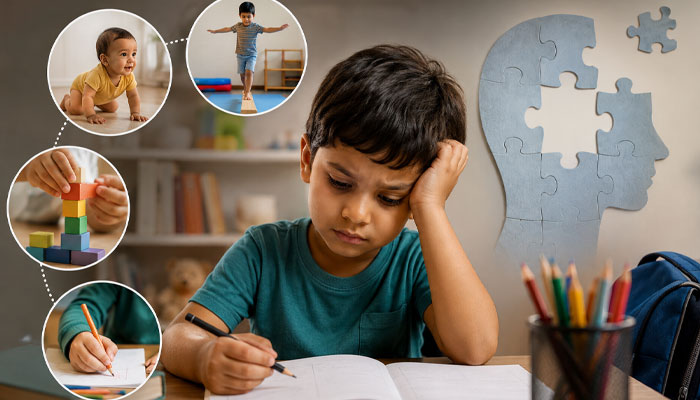
What Are Developmental Milestones?
Developmental milestones are skills that children typically develop as they grow. They provide a general framework for observing progress across different areas of development. These milestones are not limited to walking and talking; they include several important abilities that contribute to a child’s overall learning and independence.
Important developmental areas include:
- Gross motor skills – sitting, standing, walking, running, jumping, climbing, and maintaining balance.
- Fine motor skills – holding objects, using crayons and pencils, buttoning clothes, building blocks, and manipulating small items.
- Speech and communication – understanding language, expressing needs, forming words and sentences, and communicating with others.
- Cognitive skills – thinking, remembering, problem-solving, matching, sorting, and understanding concepts.
- Social and emotional skills – interacting with others, participating in play, expressing emotions, and adapting to different situations.
- Self-help skills – eating, dressing, toileting, grooming, and participating in daily routines.
When a child experiences difficulties in one or more of these areas, it may influence how comfortably they participate at home, at school, and in social environments.
Can Delayed Milestones Affect Learning?
Learning depends on many developmental abilities working together. A child needs more than academic knowledge to participate successfully in a classroom. They may need adequate posture, attention, hand control, visual-motor coordination, communication, memory, sensory regulation, and the ability to follow instructions.
For example, a child who has difficulty maintaining an upright sitting position may become tired during table activities. A child with weak hand skills may find drawing, colouring, or writing challenging. A child with communication difficulties may understand an activity but struggle to express an answer. Similarly, challenges with attention or sensory processing can make it difficult to remain engaged in a classroom task.
Therefore, what appears to be a “learning gap” may sometimes involve developmental skills that have not yet become strong enough to support learning effectively.
How Weak Gross Motor Skills May Affect Your Child
Gross motor development involves the large muscles of the body. These muscles help children maintain posture, balance, coordination, and overall body control.
A child with weak gross motor abilities may experience difficulty with activities such as running, jumping, hopping, climbing stairs, catching or throwing a ball, maintaining balance, or participating in playground games.
Core stability is also important for classroom participation. When the muscles around the trunk are not providing sufficient stability, a child may lean on the table, frequently change sitting positions, appear tired, or avoid activities that require sustained sitting.
Building gross motor skills can support better body awareness, coordination, confidence, and participation in age-appropriate physical and learning activities.
Fine Motor Skills and Classroom Learning
Fine motor skills involve controlled movements of the hands and fingers. They are essential for many preschool and school activities.
Children use fine motor skills when they:
- Hold crayons and pencils
- Draw and colour
- Write letters and numbers
- Use scissors
- Turn book pages
- Build with blocks
- Open containers
- Fasten buttons and zippers
- Use spoons and other everyday objects
If these skills are weak, children may avoid writing or colouring, take longer to complete classroom tasks, become frustrated with hand-based activities, or depend more heavily on adults.
Supporting hand strength, finger control, bilateral coordination, and visual-motor abilities can make everyday learning tasks more manageable.
Signs Parents Can Observe
Parents and teachers are often the first people to notice differences in a child’s development. It may be helpful to seek a professional developmental evaluation when difficulties are persistent or noticeably interfere with everyday participation.
Some signs that may deserve attention include:
- Difficulty achieving age-expected movement milestones
- Frequent falling or poor balance
- Difficulty running, jumping, or climbing
- Weak pencil or crayon control
- Avoiding drawing, colouring, or writing activities
- Difficulty following age-appropriate instructions
- Speech or communication difficulties
- Limited participation in peer activities
- Difficulty maintaining attention during structured activities
- Challenges with dressing, feeding, or other daily living skills
- Difficulty coordinating both sides of the body
- Frustration during tasks that require motor planning or coordination
One sign alone does not necessarily indicate a developmental problem. However, when several difficulties occur together or continue over time, a detailed assessment can help identify the areas where the child may need support.
Why Early Developmental Support Matters
Early childhood is an important period for developing movement, communication, thinking, social interaction, and independence. When developmental concerns are identified early, professionals can better understand the child’s strengths and challenges and create appropriate goals.
Early support is not about comparing one child with another. It is about helping a child develop the foundational abilities needed to participate more confidently in daily routines, play, communication, and learning.
Depending on the child’s individual needs, intervention may focus on gross motor development, fine motor coordination, sensory processing, speech and communication, attention, social interaction, self-care, or other functional skills.
How Child Development Therapy Can Support Learning
A child development program should look beyond a single symptom. For example, difficulty with handwriting may involve hand strength, posture, visual-motor coordination, attention, or motor planning. Difficulty participating in classroom activities may involve communication, sensory regulation, or understanding instructions.
For this reason, an individualized approach can be valuable. Therapy activities can be designed around a child’s developmental level, strengths, interests, and functional needs.
Through structured and engaging activities, children can practice important skills in ways that are meaningful to everyday life. Progress may gradually support better participation at school, at home, during play, and in social environments.
Advaitha Child Development Center – Supporting Every Step of Development
At Advaitha Child Development Center, children receive development-focused support based on their individual abilities and needs. Rather than focusing only on what a child finds difficult, the goal is to understand the developmental foundations behind those challenges and help strengthen them through appropriate therapeutic activities.
Families searching for the Best Child Development Center in Vijayawada should look for a center that values individualized assessment, goal-oriented intervention, parent involvement, and a child-friendly approach.
Parents also play an important role in the developmental journey. When therapists and families work together, skills practiced during therapy can be encouraged during everyday routines at home. Simple activities involving movement, play, communication, dressing, drawing, sorting, building, and interaction can provide valuable opportunities for continued learning.
Every Small Developmental Step Can Support Bigger Learning Goals
If your child is experiencing delayed milestones, weak motor skills, difficulty with coordination, communication challenges, or gaps in learning, identifying the underlying developmental needs can be an important first step.
A developmental assessment can help determine which skills are progressing well and which areas may benefit from additional support. With appropriate guidance, structured practice, and consistent encouragement, children can continue building the foundations they need for greater independence and participation.
Advaitha Child Development Center supports children in developing essential skills for movement, communication, play, daily activities, and learning. If you are searching for the Best Child Development Center in Vijayawada, consider a comprehensive developmental approach that understands your child as an individual and supports progress one meaningful milestone at a time.
Articles
- Auditory Processing Delays when Primitive Reflexes are Retained
- Aren’t Retained Primitive Reflexes Just Autistic Disorders?
- Retained Primitive Reflexes Creating Self-Esteem Issues and Self-Doubt in Kids
- Stop Using White Noise to put Babies and Toddlers to Sleep? What the Research Says
- Attention Activities Building Foundational Elements for Attention and Focus and ADHD
- 10 Brain Boosting Activities to Awaken the Brain for Learning Readiness
- In-Home Circle Time Schedule with Purposeful Movement for Therapists, Parents and Teachers
- Home-Based Circle Time Movement and Brain Break Resources for Parents and Therapists
- In-Home Movement Activities and Brain Breaks from the Best Occupational Therapists
- Gross motor skills tied to child’s brain development
- Wrapped Legs Around Chair? A Sign of Weak Core Muscle that Causes Reading and Writing Delays
- CUP STACKING: Studies Show Cup Stacking Improves Reading Test Scores and Cross-Patterning
- Jumping Toys for better Vestibular Input
- Why handwriting fails without proper Core Strength and Hand Strength
- 7 Essential Motor Skills needed for a Child to Reach Academic Success
- Are delayed milestones and weak motor skills causing gaps in my child’s learning
- The 4 Foundational Cornerstones needed to develop a Child’s Learning Readiness
- anchor-sight-word-retention-with-simple-movement-exercises
- Brain-Building Animal Movement Activities Target Learning Skills
- 7 Strategies to Accomplish Positive Compliance with Retained Primitive Reflex Integration
- Child with Zinc Deficiency may show signs of Learning Challenges
- Hands-Grasping Reflex Delays Handwriting and Speech Development if Retained
- Deep Breathing Activities to Calm Sensory Meltdowns and Ground Emotions
- 3 Retained Primitive Reflexes Responsible for Poor Balance
- toe walking
- Anxious Behavior
- Retained Primitive Reflexes that Cause Sensory Sensitivities
- Retained Primitive Reflexes Causing Picky Eating, Sugar Cravings and Compulsive Eating
- Tactile Defensiveness
- 10 Fun Activities to Boost Your Child's Speech Development
- Exploring Learning through Play: Educational Activities for Kids
- Why Crossing the Midline Activities Helped this Childrens Listen to his Teacher
- Music Therapy: Study Says Music Key for Non-Verbal Children and Children with Speech and Language Delays
- Tactile Toys for Sensory Defensiveness and Tactile Stimulation
Have any Query or Need any information about our services
