
- +91 7680015156
- advaithacdc@gmail.com
Jumping Toys for better Vestibular Input
- Home
- Blogs
- Jumping Toys for better Vestibular Input
Circle time is often associated with preschool classrooms, but it can be just as valuable at home, in therapy sessions, learning centers, and small-group environments. A thoughtfully planned in-home circle time schedule gives children a predictable routine while creating opportunities to develop communication, attention, motor coordination, social skills, body awareness, and emotional regulation.
Adding purposeful movement makes circle time even more engaging. Instead of expecting children to sit still for a long period, movement activities allow them to use their bodies while learning. For therapists, parents, and teachers, this approach can transform everyday play into meaningful opportunities for child development.
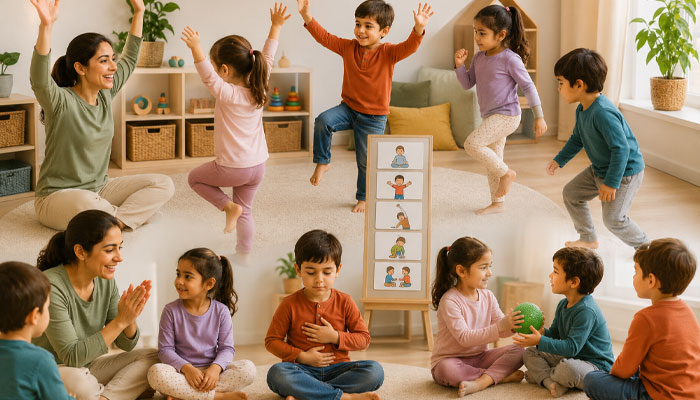
Why Is Circle Time Important for Child Development?
Young children learn best when activities are interactive, repetitive, enjoyable, and appropriate for their developmental level. Circle time combines many of these elements in one structured routine.
A consistent circle time routine can help children understand what comes next, transition between activities more comfortably, participate in group experiences, listen to simple directions, take turns, imitate actions, and communicate their needs and ideas.
When movement is incorporated naturally, children also have opportunities to strengthen gross motor skills, balance, coordination, bilateral integration, motor planning, and spatial awareness.
The goal is not to make every child sit perfectly throughout the session. Instead, the goal is to create a supportive learning experience where children can participate through looking, listening, moving, pointing, singing, speaking, imitating, or using gestures.
A Simple In-Home Circle Time Schedule
An effective circle time does not need to be long. For many young children, approximately 15 to 30 minutes is enough. Children who are younger, highly active, or still developing attention skills may benefit from even shorter sessions.
The following schedule can be adapted based on the child's age, abilities, sensory preferences, and developmental needs.
1. Welcome Song – 2 to 3 Minutes
Begin with the same simple greeting song whenever possible. Repetition provides predictability and helps children understand that circle time is beginning.
Parents, teachers, and therapists can include the child's name while singing. Encourage waving, clapping, tapping the knees, or making eye contact when appropriate.
This activity may support social awareness, imitation, listening, name recognition, early communication, and participation.
2. Body Warm-Up – 3 to 5 Minutes
Before expecting focused participation, give children an opportunity to move their bodies. Purposeful warm-up activities can include marching in place, reaching toward the ceiling, touching the toes, clapping overhead, stomping the feet, jumping, stretching the arms, or moving from side to side.
These movements can help prepare the body for learning while supporting coordination and body awareness.
Therapists can adapt movements to specific developmental goals. For example, a child working on bilateral coordination may practice movements that require both sides of the body to work together.
3. Calendar, Weather or Daily Routine – 3 Minutes
Introduce simple concepts related to the child's everyday environment. Ask questions such as, “Is it sunny or raining?” or “What are we doing today?”
For younger children, visual choices can make participation easier. Show two pictures and allow the child to point, touch, gesture, or verbally choose an answer.
This part of circle time can encourage vocabulary development, observation, sequencing, memory, and understanding of everyday routines.
4. Action Song with Cross-Body Movement – 3 to 5 Minutes
Movement songs are a valuable way to combine language with motor development. Include actions that encourage children to reach across the middle of their body.
For example, children can touch the right hand to the left knee and then the left hand to the right knee. They can also reach across the body to collect a toy, tap opposite shoulders, or follow simple cross-body dance movements.
Cross-pattern movements encourage children to coordinate both sides of the body. These skills are useful during many everyday activities, including dressing, playing, drawing, climbing, and participating in sports.
5. Story Time with Movement – 5 Minutes
Story time does not always need to involve sitting quietly. Choose a short picture book and add actions that match the story.
If the character jumps, encourage the child to jump. If an animal stretches, stretch together. If the story includes something flying, move the arms like wings.
Combining stories with movement can make books more meaningful for children who find long periods of sitting difficult. It can also support vocabulary, imagination, listening comprehension, sequencing, imitation, and engagement.
6. Movement Challenge – 3 to 5 Minutes
Create a simple movement challenge using items already available at home or in the classroom. Children might walk along a taped line, crawl through a tunnel made from cushions, step over pillows, carry a soft toy across the room, balance briefly on one foot, or toss beanbags into a basket.
The activity does not need to be complicated. The important part is choosing movement with a developmental purpose.
For example, crawling can encourage coordination between the arms and legs, balancing activities challenge postural control, and carrying objects can encourage body awareness and motor planning.
7. Calm-Down and Goodbye Routine – 2 to 3 Minutes
After active movement, finish circle time with a calming routine. Children can sit comfortably, stretch slowly, take gentle breaths, squeeze and release their hands, or listen to a quiet goodbye song.
A consistent ending helps children recognize that the activity is finished and prepares them for the next part of their day.
What Makes Movement “Purposeful”?
Purposeful movement means selecting an activity because it supports a particular developmental skill rather than adding movement only to keep children busy.
Different movement activities may support balance, strength, coordination, postural stability, motor planning, attention, body awareness, bilateral coordination, or participation in daily activities.
For example, asking a child to reach across the body for colored blocks can combine cognitive learning with cross-body coordination. Following a “jump, clap, turn” sequence combines listening, memory, sequencing, and motor planning.
How Therapists Can Use Circle Time
Occupational therapists, physiotherapists, speech therapists, developmental therapists, and early intervention professionals can modify circle time according to individual therapy goals.
A speech therapist might focus on imitation, requesting, naming, action words, turn-taking, and following directions. An occupational therapist might incorporate sensory-motor activities, fine motor preparation, bilateral coordination, and body awareness. A physiotherapist may adapt activities to encourage strength, balance, posture, mobility, and coordination.
The most effective activities are usually those that feel like play rather than repeated exercises.
How Parents Can Continue the Activities at Home
Parents do not need expensive equipment or a complicated therapy setup. Household objects such as cushions, plastic cups, balls, baskets, tape, scarves, toys, and picture cards can provide many opportunities for purposeful movement.
Keeping the routine consistent can be especially helpful. Children often participate more confidently when they know what to expect.
Parents can also observe which activities their child enjoys, avoids, finds difficult, or completes easily and share those observations with teachers or therapists.
Tips for Successful In-Home Circle Time
- Keep activities short and appropriate for the child's attention span.
- Use simple, clear instructions.
- Demonstrate movements instead of relying only on verbal directions.
- Give the child enough time to respond.
- Use songs, pictures, toys, and gestures to increase participation.
- Alternate seated activities with active movement.
- Celebrate participation rather than expecting perfect performance.
- Modify activities according to the child's developmental abilities.
- Avoid forcing movements that cause discomfort, distress, or pain.
Every Movement Can Become a Learning Opportunity
An in-home circle time routine with purposeful movement can create a natural connection between learning, communication, play, and physical development. Children do not always need to sit still to learn effectively. Movement can become an important part of how they explore their environment, understand instructions, communicate, build confidence, and develop new skills.
For therapists, parents, and teachers, the key is to keep activities playful, predictable, flexible, and meaningful. A few minutes of carefully chosen movement each day can provide valuable opportunities to practice developmental skills while helping children enjoy the learning process.
If a child consistently experiences difficulty with movement, communication, attention, sensory processing, balance, coordination, or age-appropriate developmental skills, parents can discuss their concerns with a qualified pediatrician or appropriate child development professional for individualized assessment and guidance.
Articles
- Auditory Processing Delays when Primitive Reflexes are Retained
- Aren’t Retained Primitive Reflexes Just Autistic Disorders?
- Retained Primitive Reflexes Creating Self-Esteem Issues and Self-Doubt in Kids
- Stop Using White Noise to put Babies and Toddlers to Sleep? What the Research Says
- Attention Activities Building Foundational Elements for Attention and Focus and ADHD
- 10 Brain Boosting Activities to Awaken the Brain for Learning Readiness
- In-Home Circle Time Schedule with Purposeful Movement for Therapists, Parents and Teachers
- Home-Based Circle Time Movement and Brain Break Resources for Parents and Therapists
- In-Home Movement Activities and Brain Breaks from the Best Occupational Therapists
- Gross motor skills tied to child’s brain development
- Wrapped Legs Around Chair? A Sign of Weak Core Muscle that Causes Reading and Writing Delays
- CUP STACKING: Studies Show Cup Stacking Improves Reading Test Scores and Cross-Patterning
- Jumping Toys for better Vestibular Input
- Why handwriting fails without proper Core Strength and Hand Strength
- 7 Essential Motor Skills needed for a Child to Reach Academic Success
- Are delayed milestones and weak motor skills causing gaps in my child’s learning
- The 4 Foundational Cornerstones needed to develop a Child’s Learning Readiness
- anchor-sight-word-retention-with-simple-movement-exercises
- Brain-Building Animal Movement Activities Target Learning Skills
- 7 Strategies to Accomplish Positive Compliance with Retained Primitive Reflex Integration
- Child with Zinc Deficiency may show signs of Learning Challenges
- Hands-Grasping Reflex Delays Handwriting and Speech Development if Retained
- Deep Breathing Activities to Calm Sensory Meltdowns and Ground Emotions
- 3 Retained Primitive Reflexes Responsible for Poor Balance
- toe walking
- Anxious Behavior
- Retained Primitive Reflexes that Cause Sensory Sensitivities
- Retained Primitive Reflexes Causing Picky Eating, Sugar Cravings and Compulsive Eating
- Tactile Defensiveness
- 10 Fun Activities to Boost Your Child's Speech Development
- Exploring Learning through Play: Educational Activities for Kids
- Why Crossing the Midline Activities Helped this Childrens Listen to his Teacher
- Music Therapy: Study Says Music Key for Non-Verbal Children and Children with Speech and Language Delays
- Tactile Toys for Sensory Defensiveness and Tactile Stimulation
Have any Query or Need any information about our services
