- +91 7680015156
- advaithacdc@gmail.com
Anchor sight word retention with simple movement exercises
- Home
- Blogs
- Anchor sight word retention with simple movement exercises
Learning sight words is an important step in a child’s early reading journey. Words such as “the,” “and,” “is,” “you,” “can,” and “here” appear frequently in everyday reading. When children recognize these words quickly without having to sound them out each time, reading can become smoother and more confident. However, some children may need additional practice and a more engaging learning approach to remember sight words consistently.
One useful approach is to combine sight word practice with simple body movements. Instead of asking a child to sit at a table and repeatedly read or memorize words, movement-based activities encourage the child to see, say, hear, and physically respond to a word. At Advaitha Child Development Center, learning activities can be adapted to support each child’s developmental abilities, attention, communication, and participation.
For parents searching for the Best Child Development Center in Vijayawada, understanding how structured, playful activities can support learning is an important part of choosing appropriate developmental support for their child.
What Is Sight Word Retention?
Sight word retention refers to a child’s ability to remember and recognize frequently used words after repeated exposure. Rather than decoding the same word every time it appears, the child gradually learns to identify it quickly.
Strong sight word recognition may help children improve reading fluency, sentence understanding, classroom participation, and confidence while reading. However, children develop these skills at different rates. Some may learn a new word after seeing it a few times, while others benefit from frequent repetition presented through different activities.
This is where movement-based learning can make practice more interactive and meaningful.
Why Combine Movement with Sight Words?
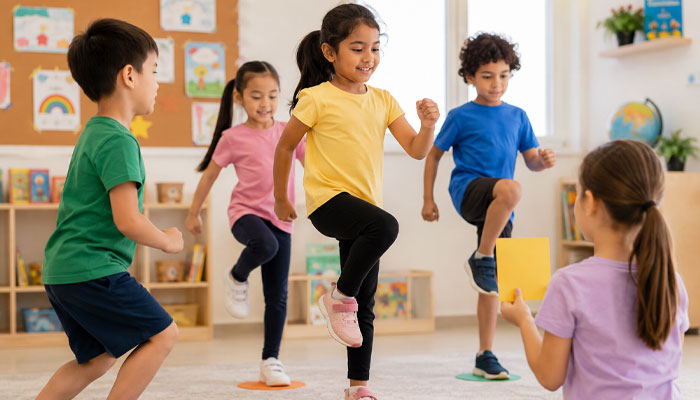
Children naturally enjoy moving, jumping, reaching, clapping, walking, and playing. Incorporating these movements into learning can turn a repetitive literacy task into an active experience. A child may be asked to jump toward the correct word card, clap while saying a word, touch a word placed on a wall, or perform a simple action after identifying the correct word.
These activities create opportunities to combine visual recognition, listening, verbal responses, and physical movement. For some children, this multi-sensory style of learning may help maintain attention and provide additional opportunities to practice the same word without making the activity feel repetitive.
1. Sight Word Jump Activity
Place several sight word cards on the floor with enough space between them. Say one word aloud and encourage the child to find the matching card and jump toward it. After reaching the card, ask the child to say the word again.
For example, place cards containing “go,” “come,” “see,” and “here” on the floor. When you say “see,” the child identifies the correct card, jumps to it, and repeats “see.”
This simple exercise combines word recognition with gross motor movement and can make repeated practice more enjoyable.
2. Clap and Say the Word
Clapping is one of the easiest movements to add to a sight word activity. Show the child a sight word card and encourage them to read or repeat the word while clapping.
You can also create a simple pattern such as “clap, clap, say the word.” Keeping the activity predictable can help the child understand what is expected and participate more independently over time.
Once the child becomes familiar with the activity, introduce a small number of new words while continuing to review previously learned words.
3. Walk to the Correct Word
Place sight word cards in different areas of a room. Call out a word and ask the child to walk to the matching card. Depending on the child’s ability, you can vary the movement by asking them to take big steps, small steps, side steps, or march toward the word.
The main goal should remain word recognition rather than making the physical activity difficult. Movement should be simple, safe, and appropriate for the child’s developmental level.
4. Touch, Say, and Move
Attach a few word cards to a wall at a comfortable height. Ask the child to find a particular word, touch it, say it, and complete a simple movement such as raising both hands, turning around, or touching their knees.
For example:
- Find “the” and raise your hands.
- Find “you” and clap twice.
- Find “go” and take two steps forward.
- Find “can” and touch your shoulders.
This creates a clear connection between identifying the word and completing an action.
5. Sight Word Action Trail
Create a short movement trail using four or five sight word cards. The child moves from one card to another while reading or repeating each word. One station might involve stepping over a soft obstacle, another may involve touching a cone, and another may involve standing on a marked spot while saying the word.
Keep the sequence short initially. As the child becomes comfortable with the activity, you can gradually add more words or change their positions. Repeating familiar words in slightly different movement activities may help keep practice interesting.
Repetition Is Important for Retention
Learning does not always happen after a single activity. Repeated exposure is often important for developing familiarity with sight words. Instead of introducing many new words at once, parents and educators can focus on a small group of words and practice them regularly.
For example, select three to five words for the week. Use the same words during jumping games, matching activities, story time, flashcard practice, and simple movement exercises. Once the child recognizes them more consistently, gradually introduce additional words while continuing to review earlier ones.
Short, positive practice sessions can often be more manageable than long learning sessions, particularly for children who find sustained attention challenging.
How Movement Activities Support Overall Development
Movement-based sight word exercises are not only about reading practice. Depending on how the activity is designed, children may also have opportunities to work on following instructions, motor planning, coordination, balance, attention, waiting for their turn, listening, and communication.
For example, a child who hears “Find the word ‘come,’ jump to it, and clap twice” is processing a verbal instruction, visually searching for the correct word, planning a physical response, completing the movement, and recalling the word.
Activities should always be adjusted according to the individual child rather than expecting every child to complete the same task in the same way.
Tips for Parents Practicing Sight Words at Home
Parents can easily incorporate movement-based sight word practice into everyday routines. You do not need complicated equipment. Simple paper word cards and a safe space to move are often enough.
- Begin with a small number of familiar words.
- Keep activities short and engaging.
- Use clear and simple instructions.
- Give the child enough time to respond.
- Repeat words across different activities.
- Appreciate effort and participation.
- Avoid comparing the child’s progress with other children.
- Gradually increase difficulty based on the child’s comfort and ability.
Most importantly, learning activities should remain encouraging. When children associate learning with positive experiences, they may be more willing to participate and practice.
Individualized Learning at Advaitha Child Development Center
Every child has a unique developmental profile. One child may respond well to visual activities, another may enjoy movement-based learning, while another may require additional prompting, repetition, or structured support. Understanding these differences can help professionals select activities that are meaningful and appropriate for the individual child.
At Advaitha Child Development Center, child-focused developmental activities can incorporate play, movement, communication, sensory experiences, and structured learning opportunities based on individual needs. The aim is to encourage participation and support the development of functional skills in an engaging environment.
Families looking for the Best Child Development Center in Vijayawada can benefit from choosing a center that recognizes individual differences and works toward meaningful developmental goals rather than relying on a one-size-fits-all approach.
Making Learning Active and Enjoyable
Anchoring sight word retention through simple movement exercises can transform regular word practice into an active learning experience. Jumping to a word, walking toward the correct card, clapping while saying it, or following a small movement trail gives children repeated opportunities to interact with words in different ways.
The activity does not need to be complicated. Consistency, repetition, appropriate challenge, and encouragement are key. When learning activities are adapted to a child’s abilities and interests, they can create meaningful opportunities for participation and skill development.
Advaitha Child Development Center focuses on creating supportive developmental experiences where children can learn through structured activities, interaction, play, and movement. If you are searching for the Best Child Development Center in Vijayawada, individualized developmental support and engaging learning strategies can be important factors in helping your child progress step by step.
Articles
- Auditory Processing Delays when Primitive Reflexes are Retained
- Aren’t Retained Primitive Reflexes Just Autistic Disorders?
- Retained Primitive Reflexes Creating Self-Esteem Issues and Self-Doubt in Kids
- Stop Using White Noise to put Babies and Toddlers to Sleep? What the Research Says
- Attention Activities Building Foundational Elements for Attention and Focus and ADHD
- 10 Brain Boosting Activities to Awaken the Brain for Learning Readiness
- In-Home Circle Time Schedule with Purposeful Movement for Therapists, Parents and Teachers
- Home-Based Circle Time Movement and Brain Break Resources for Parents and Therapists
- In-Home Movement Activities and Brain Breaks from the Best Occupational Therapists
- Gross motor skills tied to child’s brain development
- Wrapped Legs Around Chair? A Sign of Weak Core Muscle that Causes Reading and Writing Delays
- CUP STACKING: Studies Show Cup Stacking Improves Reading Test Scores and Cross-Patterning
- Jumping Toys for better Vestibular Input
- Why handwriting fails without proper Core Strength and Hand Strength
- 7 Essential Motor Skills needed for a Child to Reach Academic Success
- Are delayed milestones and weak motor skills causing gaps in my child’s learning
- The 4 Foundational Cornerstones needed to develop a Child’s Learning Readiness
- anchor-sight-word-retention-with-simple-movement-exercises
- Brain-Building Animal Movement Activities Target Learning Skills
- 7 Strategies to Accomplish Positive Compliance with Retained Primitive Reflex Integration
- Child with Zinc Deficiency may show signs of Learning Challenges
- Hands-Grasping Reflex Delays Handwriting and Speech Development if Retained
- Deep Breathing Activities to Calm Sensory Meltdowns and Ground Emotions
- 3 Retained Primitive Reflexes Responsible for Poor Balance
- toe walking
- Anxious Behavior
- Retained Primitive Reflexes that Cause Sensory Sensitivities
- Retained Primitive Reflexes Causing Picky Eating, Sugar Cravings and Compulsive Eating
- Tactile Defensiveness
- 10 Fun Activities to Boost Your Child's Speech Development
- Exploring Learning through Play: Educational Activities for Kids
- Why Crossing the Midline Activities Helped this Childrens Listen to his Teacher
- Music Therapy: Study Says Music Key for Non-Verbal Children and Children with Speech and Language Delays
- Tactile Toys for Sensory Defensiveness and Tactile Stimulation
Have any Query or Need any information about our services
