
Children learn about their bodies and the world around them through movement. Activities such as running, jumping, swinging, climbing, spinning, and balancing are not only fun but also provide valuable sensory experiences. One important sensory system involved in these activities is the vestibular system. It helps children understand movement, balance, body position, and changes in direction.
Jumping toys can be a playful way to provide movement experiences for children. When selected appropriately and used with adult supervision, they may encourage balance, coordination, body awareness, and gross motor participation. At Advaitha Child Development Center, activities can be planned according to each child's developmental abilities and individual needs. For parents searching for the Best Child Development Center in Vijayawada, understanding the role of sensory-motor activities can help them make informed choices about their child's developmental support.
What Is the Vestibular System?
The vestibular system is a sensory system associated with the inner ear. It provides the brain with information about head movement, gravity, balance, and spatial orientation. Whenever a child jumps, swings, bends, rolls, climbs, or changes direction, the vestibular system receives information about that movement.
Vestibular processing works together with vision and proprioception—the body's awareness of muscles and joints—to support coordinated movement. These systems help a child maintain posture, move through different environments, adjust body position, and participate in everyday physical activities.
Why Is Vestibular Input Important for Children?
Movement experiences are an important part of childhood. Appropriate vestibular input can contribute to the development of balance, postural control, coordination, and body awareness. It may also influence how comfortably a child participates in playground activities, physical games, classroom routines, and daily tasks.
Every child responds differently to movement. Some children actively seek jumping, spinning, or climbing, while others may feel uncomfortable with fast movement or changes in position. Because sensory responses vary, activities should be matched to the child's comfort, developmental level, and safety needs rather than following a one-size-fits-all approach.
How Do Jumping Toys Provide Vestibular Input?
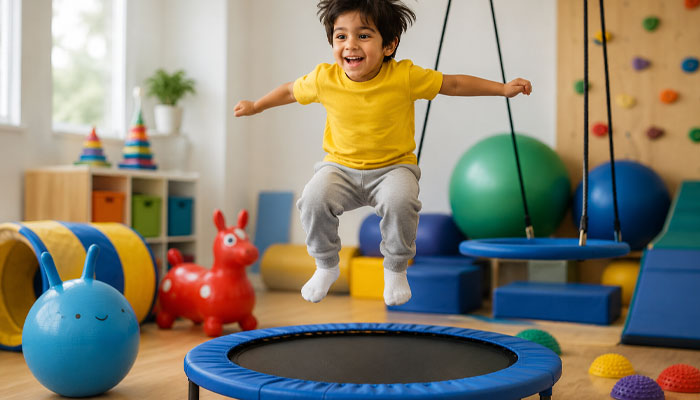
Jumping involves repeated upward and downward movement, changes in head position, and active use of the legs and trunk. These movements provide sensory information to the vestibular system while also engaging muscles and joints. This makes jumping a useful gross motor activity that combines several forms of sensory feedback.
Depending on the toy and activity, children may practise taking off with both feet, landing safely, maintaining balance, controlling speed, and adjusting their posture. The goal is not simply to make a child jump more. The activity should be purposeful, enjoyable, safe, and suitable for the child's abilities.
Jumping Toys That Can Encourage Movement
Different types of jumping equipment can create different movement experiences. A small trampoline with appropriate safety features may encourage repeated bouncing. Hopper balls require children to hold, balance, and coordinate their bodies while bouncing. Soft jumping pads, floor markers, sensory stepping paths, and foam obstacles can also turn jumping into a structured play activity.
Other simple activities do not require specialised equipment. Children can jump between marked spots, jump over soft objects, follow coloured floor targets, imitate animal jumps, or complete a simple movement course. These activities can be modified based on age, motor ability, attention, and confidence.
Developmental Skills Supported Through Jumping Activities
1. Balance and Postural Control
Jumping requires a child to maintain stability before, during, and after movement. Repeated practice can challenge the child to control the trunk and adjust body position while landing or changing direction.
2. Gross Motor Coordination
To jump effectively, the legs, core, arms, and visual system need to work together. Activities involving jumping forward, sideways, or between targets can provide opportunities to practise coordinated whole-body movement.
3. Body Awareness
Jumping gives children feedback about how much force they are using, where their feet are positioned, and how their body moves through space. This combination of vestibular and proprioceptive information can support body awareness during play.
4. Motor Planning
A jumping obstacle course can encourage children to think about what movement comes next. For example, a child may jump onto a marker, step over a block, crawl through a tunnel, and then jump again. Sequencing these movements provides opportunities to practise motor planning.
5. Active Play and Participation
Jumping activities can make movement sessions engaging and interactive. When children enjoy an activity, they may be more willing to participate, explore new movements, follow instructions, and interact with therapists, parents, or peers.
Making Jumping Activities Fun and Purposeful
Jumping activities can be incorporated into games instead of being treated as repetitive exercises. A therapist or parent might create a colour-jumping game in which the child jumps to a colour that is called out. Numbers, letters, pictures, or simple instructions can also be added to combine movement with attention and learning.
A child might jump like a frog, pretend to be a kangaroo, move between imaginary islands, or complete a treasure-hunt obstacle course. The activity can be made easier or more challenging depending on the child's abilities. This playful approach helps keep the experience motivating while providing meaningful movement opportunities.
Why Individualized Sensory Activities Matter
A jumping activity that is enjoyable for one child may be overwhelming or difficult for another. Some children may seek frequent movement, while others may avoid jumping, swinging, or unstable surfaces. Children may also differ in balance, muscle strength, coordination, attention, communication, and confidence.
For this reason, sensory-motor activities should be individualized. A qualified professional can observe the child's responses and decide whether an activity should be slowed down, simplified, modified, or combined with other forms of movement. The child's comfort and safety should always guide the activity.
Safety Tips When Using Jumping Toys
Adult supervision is important whenever children use jumping equipment. Toys should be age-appropriate, stable, and used according to manufacturer safety guidance. The surrounding area should be clear of sharp objects and unnecessary obstacles, and the landing surface should be appropriate for the activity.
Children should not be forced to continue an activity if they appear frightened, dizzy, uncomfortable, unusually tired, or unsteady. If parents have concerns about their child's balance, coordination, sensory responses, or developmental skills, they should seek guidance from an appropriate healthcare or child-development professional before introducing challenging movement activities.
Supporting Development at Advaitha Child Development Center
At Advaitha Child Development Center, the focus is on understanding each child's individual developmental needs and supporting participation through meaningful, child-friendly activities. Movement-based activities may be incorporated into a broader developmental plan when appropriate for the child.
Rather than using the same activity for every child, professionals can consider factors such as sensory preferences, gross motor abilities, communication, attention, coordination, and functional goals. Parents searching online for the Best Child Development Center in Vijayawada can look for a center that values individualized assessment, family involvement, safe therapeutic practices, and developmentally appropriate activities.
How Parents Can Encourage Healthy Movement at Home
Parents can encourage movement through simple daily play. Jumping between floor markers, dancing to music, walking along a safe balance line, playing catch, climbing age-appropriate playground equipment, and completing simple obstacle courses can make physical activity enjoyable.
The most important point is to observe the child's response. Movement should feel playful rather than stressful. Start with simple activities, allow breaks, and gradually introduce new challenges based on the child's confidence and abilities. If a therapist has provided specific recommendations, parents should follow those instructions when practising activities at home.
Jump, Play, Learn and Grow
Jumping toys can offer much more than energetic play. When used appropriately, jumping activities provide vestibular and proprioceptive experiences while creating opportunities to practise balance, coordination, body awareness, postural control, and motor planning.
At Advaitha Child Development Center, sensory and movement activities can be selected according to the child's unique developmental profile. If you are looking for the Best Child Development Center in Vijayawada, consider professional support that focuses on individualized goals, safe participation, and enjoyable learning experiences that help children build skills through meaningful play.
