
Handwriting is often considered a simple academic skill, but for a child, writing involves much more than holding a pencil and forming letters. Good handwriting requires coordination between posture, shoulder stability, core muscles, arms, wrists, hands, fingers, vision, and attention. When a child has difficulty with handwriting, parents may focus mainly on pencil grip or repeated writing practice. However, the underlying difficulty may sometimes be related to weak core strength and hand strength.
At Advaitha Child Development Center, children are supported through development-focused activities based on their individual needs. For parents searching for the Best Child Development Center in Vijayawada, understanding the physical foundations of handwriting can help them recognize why some children need more than handwriting practice alone.
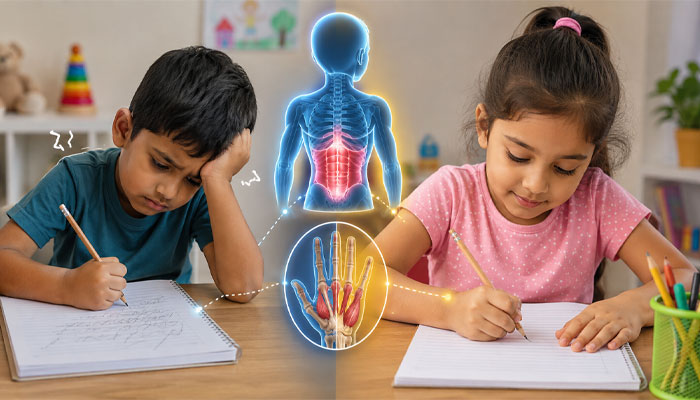
Handwriting Is a Whole-Body Activity
When we watch a child write, most of our attention naturally goes to the fingers and pencil. But the body works as a connected system. Before the fingers can perform small and controlled movements, the child needs a stable base from the trunk and shoulders.
Imagine trying to draw a detailed picture while sitting on an unstable chair. Even if your fingers are strong, controlling the pencil becomes more difficult because the rest of your body is constantly trying to maintain balance. A similar situation can occur when a child has reduced core stability. The child may use extra energy simply to maintain an upright sitting position, leaving less control and endurance for handwriting.
What Is Core Strength?
Core strength refers to the strength and stability of the muscles around the abdomen, back, pelvis, and trunk. These muscles help children maintain posture and provide a stable foundation for movements of the arms and hands.
During writing, adequate core stability helps a child sit upright at a desk without constantly leaning, slouching, or supporting the head and body with the arms. When the trunk is stable, the shoulders and arms can move more efficiently, allowing the hands and fingers to focus on precise pencil movements.
Signs That Core Weakness May Be Affecting Handwriting
Children with reduced postural strength or endurance may show certain behaviours during table activities. These signs do not automatically indicate a developmental problem, but they may suggest that the child is finding seated tasks physically demanding.
- Slouching frequently while writing or drawing
- Leaning heavily on the desk
- Resting the head on one hand while writing
- Frequently changing sitting positions
- Becoming tired during longer writing activities
- Avoiding table-based activities
- Having difficulty maintaining an upright seated posture
- Using excessive body movement while writing
Improving the physical foundation for seated activities can make it easier for some children to participate in writing, drawing, colouring, and classroom tasks.
Why Hand Strength Matters for Handwriting
Once the trunk and shoulders provide stability, the hands need enough strength and coordination to control the pencil. Hand strength supports pencil grip, pressure control, finger movements, endurance, and manipulation of classroom tools.
A child with limited hand strength may hold the pencil very tightly in an attempt to gain control. Another child may use a loose grip and struggle to produce clear marks on paper. Some children may begin writing well but quickly complain that their hands are tired.
Handwriting requires a balance between strength and precision. The goal is not simply to make the hands stronger; children also need controlled finger movements, bilateral coordination, wrist stability, and appropriate pencil manipulation.
Common Signs of Reduced Hand Strength
- Hand fatigue during writing or colouring
- Difficulty maintaining a functional pencil grip
- Very light or excessive pencil pressure
- Difficulty using scissors effectively
- Trouble manipulating small objects
- Slow writing speed
- Avoidance of drawing, colouring, or writing
- Difficulty with buttons, zippers, or other fine motor activities
The Connection Between Core Strength, Shoulder Stability and Hand Control
Child development generally progresses from stability toward refined movement. A stable trunk supports the shoulders, stable shoulders support the arms, and controlled arms provide a foundation for precise hand and finger movements.
This is why focusing only on letter formation may not always solve handwriting difficulties. If a child is struggling to stabilize the body, shoulder, or wrist, repeatedly asking the child to write pages of letters may increase frustration without addressing the underlying skill.
Developmental activities can therefore include gross motor and fine motor components. Depending on a child's needs, therapists may work on postural control, shoulder stability, hand strength, finger dexterity, visual-motor integration, bilateral coordination, and motor planning.
Activities That Can Support Core Strength
Children can develop core strength naturally through active play. Activities should be appropriate for the child's age, abilities, and developmental needs.
- Crawling and obstacle-course activities
- Animal walks such as bear walks
- Climbing activities
- Supervised balance games
- Ball activities
- Age-appropriate yoga poses
- Movement games that involve reaching and balancing
- Activities performed in different developmental positions
These activities can help children build body awareness, endurance, balance, and postural control while keeping movement enjoyable.
Activities That Can Support Hand Strength
Fine motor development does not have to begin with worksheets. Play-based activities can provide valuable opportunities for children to strengthen their hands and practice controlled finger movements.
- Squeezing, rolling, and shaping play dough
- Using child-safe tongs or tweezers
- Building with blocks and construction toys
- Tearing and crumpling paper for craft activities
- Threading beads
- Using clips or clothespins in supervised games
- Drawing and colouring on vertical surfaces
- Age-appropriate cutting and craft activities
Why Repeated Handwriting Practice Alone May Not Be Enough
Practice is important when children are learning to write, but the quality of practice matters. If the child does not yet have sufficient postural endurance, hand control, visual-motor skills, or coordination, excessive handwriting practice can become tiring and discouraging.
Instead of viewing poor handwriting as laziness or lack of effort, it is helpful to observe how the child performs the task. Does the child become tired quickly? Is sitting upright difficult? Does the child constantly adjust the pencil? Is writing significantly harder than other learning activities? These observations can provide useful information about the skills that may need support.
Supporting Handwriting Development at Advaitha Child Development Center
Every child's developmental profile is different. At Advaitha Child Development Center, the focus is on understanding the child's abilities and identifying areas where additional developmental support may be beneficial.
Rather than looking at handwriting as an isolated classroom task, developmental professionals can consider the broader skills involved, including gross motor abilities, fine motor coordination, posture, hand function, sensory processing, attention, and visual-motor integration. Activities can then be planned according to the child's individual requirements.
When Should Parents Consider Professional Guidance?
Children develop handwriting skills at different rates, and occasional difficulty is common while learning. However, parents may consider seeking professional guidance when handwriting challenges persist, interfere with school participation, cause significant frustration, or occur alongside difficulties with posture, fine motor activities, self-care tasks, or coordination.
Early observation can help identify the specific skills that need support. The objective should not simply be beautiful handwriting. More importantly, children should be able to participate in writing tasks with appropriate comfort, control, confidence, and independence.
Best Child Development Center in Vijayawada for Developmental Support
If you are looking for the Best Child Development Center in Vijayawada to support your child's developmental journey, Advaitha Child Development Center provides child-focused services designed around individual developmental needs. Understanding the connection between core strength, hand strength, and handwriting can help parents take a broader approach to their child's learning and functional abilities.
Strong handwriting begins with more than a pencil. A stable body provides the foundation, the shoulders and wrists provide control, and the hands and fingers perform the precise movements needed for writing. By supporting these foundational abilities through meaningful movement, play, and appropriate therapeutic activities, children can work toward better participation in handwriting and other everyday learning tasks.
