
- +91 7680015156
- advaithacdc@gmail.com
Wrapped Legs Around Chair? A Sign of Weak Core Muscle that Causes Reading and Writing Delays
- Home
- Blogs
- Wrapped Legs Around Chair? A Sign of Weak Core Muscle that Causes Reading and Writing Delays
Have you noticed your child wrapping their legs around the legs of a chair while reading, writing, drawing, or doing homework? At first, it may simply look like a comfortable sitting habit. However, in some children, this posture may be a clue that they are looking for extra stability because their core muscles are not providing enough support.
Core strength plays an important role in a child’s posture, balance, coordination, attention, handwriting, and classroom participation. When the trunk is not stable enough, a child may use alternative positions such as hooking the feet around chair legs, leaning heavily on the desk, sitting on one leg, slouching, or constantly changing position.
It is important to understand that wrapping the legs around a chair does not automatically mean a child has a developmental problem. Children often change positions for comfort. But when this habit happens frequently along with poor posture, fatigue, difficulty sitting still, messy handwriting, or reduced attention during desk work, it may be worth looking more closely at core strength and postural control.
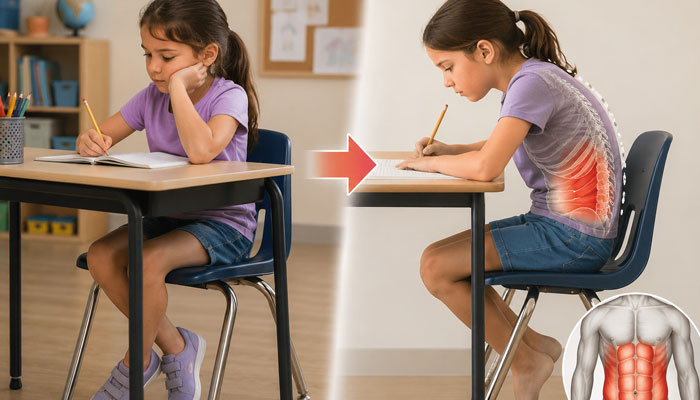
What Are Core Muscles?
The core is more than just the abdominal muscles. It includes the muscles around the abdomen, back, pelvis, hips, and trunk. These muscles work together to keep the body stable when a child sits, stands, walks, runs, reaches, writes, or plays.
A strong and well-coordinated core gives the arms and hands a stable base to work from. This is especially important during school activities. Before a child can control a pencil efficiently, their shoulders and trunk need to remain steady. If the body is constantly working hard just to stay upright, less energy may be available for reading, writing, listening, and completing tasks.
Why Do Some Children Wrap Their Legs Around a Chair?
Some children wrap their legs around chair legs to create a wider and more secure base of support. By pressing or hooking their legs against the chair, they may feel more stable through the hips and pelvis.
This extra stability can reduce the effort needed to maintain an upright sitting position. In other words, the child may be using the chair to help their body stay organised.
You may also notice other postural habits, such as:
- Leaning the chest heavily against the table
- Resting the head on one hand while writing
- Slouching down in the chair
- Sitting with one or both feet tucked underneath the body
- Frequently changing sitting positions
- Wrapping the feet around chair legs
- Using one hand to support the body instead of using it for the task
- Complaining of tiredness during homework
These behaviours can have several causes, including habit, chair height, sensory preferences, attention differences, joint flexibility, fatigue, or reduced postural endurance. Core weakness is only one possible factor.
How Can Weak Core Strength Affect Reading?
Reading is often thought of as a purely academic skill, but the body also plays an important role. A child needs enough postural control to sit comfortably, keep the head stable, maintain an appropriate viewing distance, and sustain attention on a book or worksheet.
If sitting upright requires too much effort, the child may become physically tired before the reading activity is complete. They may start shifting around, leaning on the table, putting their head down, or avoiding reading tasks altogether.
This can indirectly affect reading performance because the child is spending extra energy managing their body instead of focusing fully on the words, sentences, and meaning of the text.
Core weakness itself does not directly cause a reading disorder. However, poor postural endurance can make classroom participation and sustained reading more difficult for some children.
How Can Core Strength Affect Writing?
Writing requires a coordinated sequence of movements involving the trunk, shoulder, arm, wrist, hand, and fingers. The trunk acts as the foundation for these movements.
When the core is stable, the shoulder can move efficiently and the hand can perform small, controlled movements. When the trunk is unstable, the child may compensate by gripping the pencil too tightly, pressing heavily on the paper, leaning across the desk, or moving the whole arm instead of using refined finger movements.
Possible signs that postural weakness may be affecting writing include:
- Poor sitting posture during handwriting
- Slow writing speed
- Large or inconsistent letter formation
- Difficulty staying on the line
- Frequent hand fatigue
- Very light or very heavy pencil pressure
- Complaints that writing is tiring
- Supporting the head with one hand while writing
- Avoiding colouring, drawing, or written homework
Again, handwriting difficulties can have many causes, including fine-motor challenges, visual-motor skills, learning difficulties, attention problems, and limited practice. A professional assessment can help identify the main reason.
What Is Postural Control?
Postural control is the ability to maintain a stable body position while performing another task. Children use postural control when they sit upright during class, reach for objects without falling, balance during play, and use both hands together.
Good postural control develops gradually through movement experiences such as tummy time, crawling, climbing, rolling, jumping, balancing, playground activities, and active play.
Children who have difficulty with postural control may appear floppy, restless, easily tired, or unusually dependent on furniture for support.
Simple Activities That Can Help Build Core Strength
Core-strengthening activities do not need to feel like exercise. For children, the best approach is usually playful movement.
Activities that may support core strength and postural endurance include:
- Animal walks: Bear walks, crab walks, frog jumps, and crawling games strengthen the shoulders, trunk, and hips.
- Plank games: Short, age-appropriate plank holds can build trunk stability.
- Bridging: Lying on the back and lifting the hips can strengthen the glutes and core.
- Superman holds: Lying on the stomach and gently lifting the arms and legs can strengthen the back muscles.
- Wheelbarrow walking: One person holds the child’s legs while the child walks forward on the hands.
- Climbing: Playground climbing equipment encourages whole-body strength and coordination.
- Balance activities: Standing on one foot, walking along a line, or using stepping stones can improve postural control.
- Ball games: Sitting on a therapy ball with appropriate supervision can challenge trunk stability.
- Floor play: Building blocks, puzzles, and drawing while lying on the stomach can strengthen the shoulders and back.
Activities should be appropriate for the child’s age, abilities, and safety needs. If a child has pain, a diagnosed medical condition, or significant movement difficulties, professional guidance is recommended before starting a new exercise programme.
Check the Child’s Chair and Table Too
Sometimes a child wraps their legs around a chair simply because the furniture does not fit their body properly.
Ideally, the child should be able to sit with their back supported, hips and knees comfortably bent, and feet resting on the floor or a foot support. The table should also be at a suitable height so the shoulders do not need to lift excessively.
If the chair is too high and the feet are dangling, children may instinctively hook their legs around the chair for stability. Providing a footrest can sometimes make sitting much easier.
When Should Parents Seek Professional Advice?
Consider speaking with a pediatrician, occupational therapist, physiotherapist, or developmental professional if your child frequently struggles to maintain an upright posture or if the sitting behaviour is accompanied by other concerns.
Professional assessment may be helpful when you notice persistent difficulty with handwriting, poor balance, frequent falls, low endurance, delayed motor skills, unusual sitting patterns, difficulty participating in sports, or significant problems completing classroom tasks.
An occupational therapist can assess posture, fine-motor skills, handwriting, sensory processing, coordination, and functional classroom performance. A physiotherapist can assess strength, balance, mobility, movement patterns, and gross-motor development.
Support the Body to Support Learning
Reading and writing require much more than strong academic skills. Children also need a body that can remain stable, comfortable, and organised long enough to complete the task.
If your child regularly wraps their legs around a chair, do not immediately assume something is wrong. Observe the bigger picture. Are they also slouching? Do they tire quickly? Do they dislike handwriting? Are their feet unsupported? Do they struggle with balance or coordination?
Small changes such as better seating, regular movement breaks, active play, and age-appropriate core-strengthening activities may make desk work more comfortable. If concerns continue, an assessment from a qualified child-development professional can help identify what your child needs.
Early support can help children build the postural strength, confidence, and coordination they need to participate more comfortably in reading, writing, play, and everyday learning.
Articles
- Auditory Processing Delays when Primitive Reflexes are Retained
- Aren’t Retained Primitive Reflexes Just Autistic Disorders?
- Retained Primitive Reflexes Creating Self-Esteem Issues and Self-Doubt in Kids
- Stop Using White Noise to put Babies and Toddlers to Sleep? What the Research Says
- Attention Activities Building Foundational Elements for Attention and Focus and ADHD
- 10 Brain Boosting Activities to Awaken the Brain for Learning Readiness
- In-Home Circle Time Schedule with Purposeful Movement for Therapists, Parents and Teachers
- Home-Based Circle Time Movement and Brain Break Resources for Parents and Therapists
- In-Home Movement Activities and Brain Breaks from the Best Occupational Therapists
- Gross motor skills tied to child’s brain development
- Wrapped Legs Around Chair? A Sign of Weak Core Muscle that Causes Reading and Writing Delays
- CUP STACKING: Studies Show Cup Stacking Improves Reading Test Scores and Cross-Patterning
- Jumping Toys for better Vestibular Input
- Why handwriting fails without proper Core Strength and Hand Strength
- 7 Essential Motor Skills needed for a Child to Reach Academic Success
- Are delayed milestones and weak motor skills causing gaps in my child’s learning
- The 4 Foundational Cornerstones needed to develop a Child’s Learning Readiness
- anchor-sight-word-retention-with-simple-movement-exercises
- Brain-Building Animal Movement Activities Target Learning Skills
- 7 Strategies to Accomplish Positive Compliance with Retained Primitive Reflex Integration
- Child with Zinc Deficiency may show signs of Learning Challenges
- Hands-Grasping Reflex Delays Handwriting and Speech Development if Retained
- Deep Breathing Activities to Calm Sensory Meltdowns and Ground Emotions
- 3 Retained Primitive Reflexes Responsible for Poor Balance
- toe walking
- Anxious Behavior
- Retained Primitive Reflexes that Cause Sensory Sensitivities
- Retained Primitive Reflexes Causing Picky Eating, Sugar Cravings and Compulsive Eating
- Tactile Defensiveness
- 10 Fun Activities to Boost Your Child's Speech Development
- Exploring Learning through Play: Educational Activities for Kids
- Why Crossing the Midline Activities Helped this Childrens Listen to his Teacher
- Music Therapy: Study Says Music Key for Non-Verbal Children and Children with Speech and Language Delays
- Tactile Toys for Sensory Defensiveness and Tactile Stimulation
Have any Query or Need any information about our services
