
Every child learns in a unique way. Before a child can confidently read, write, communicate, follow classroom instructions, solve problems, or participate in academic activities, several important developmental abilities need to be established. These abilities together create what we call learning readiness.
Learning readiness is not simply about knowing alphabets, numbers, colours, or shapes. It involves the child’s ability to regulate their body, process sensory information, communicate effectively, interact with others, concentrate, and participate in purposeful activities.
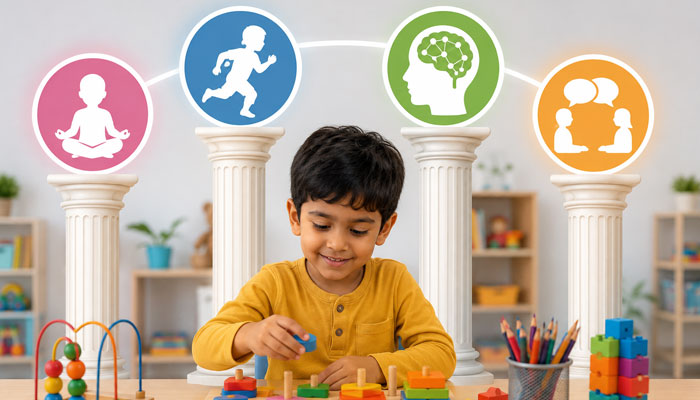
At Advaitha Child Development Center, we understand that strong foundational skills can support a child's participation in learning and everyday activities. Families searching for the Best Child Development Center in Vijayawada often want to understand which developmental areas should be strengthened before expecting better academic performance.
Here are four foundational cornerstones that play an important role in developing a child’s learning readiness.
1. Sensory Processing and Regulation
A child constantly receives information through different sensory systems. These include touch, vision, hearing, taste, smell, movement, body awareness, and internal body sensations. The brain needs to receive, organise, and respond appropriately to this sensory information.
Sensory regulation can influence how comfortably a child participates in learning activities. For example, some children may become distracted by classroom sounds, avoid certain textures, constantly seek movement, find it difficult to remain seated, or become overwhelmed in busy environments.
When a child is appropriately regulated, it may become easier to focus on the teacher, participate in activities, transition between tasks, and remain engaged for longer periods.
Activities That Can Support Sensory Development
- Jumping and movement-based play
- Swings and balance activities under appropriate supervision
- Sand, clay, water, and other tactile activities
- Pushing, pulling, and carrying age-appropriate objects
- Obstacle courses and movement games
- Activities involving different safe textures
Sensory activities should be selected according to the individual needs of the child rather than following the same approach for every child. Professional assessment can help identify specific sensory challenges when they interfere with everyday participation.
2. Motor Skills and Body Awareness
Movement is closely connected with a child’s participation in everyday learning. Children need both gross motor skills and fine motor skills for many school and daily activities.
Gross motor skills involve larger body movements such as running, jumping, climbing, balancing, sitting with stability, and coordinating both sides of the body. Fine motor skills involve smaller and more controlled movements of the hands and fingers.
Before expecting a child to write neatly, cut with scissors, colour within boundaries, or manipulate small classroom materials, it is helpful to build adequate postural control, shoulder stability, hand strength, bilateral coordination, and visual-motor abilities.
Motor Skills Important for Learning Readiness
- Core strength and postural stability
- Balance and coordination
- Hand-eye coordination
- Bilateral coordination
- Finger strength and dexterity
- Pencil control and pre-writing abilities
- Motor planning and body awareness
Activities such as block building, threading beads, puzzles, colouring, ball games, climbing, jumping, sorting objects, and age-appropriate obstacle courses can make motor development enjoyable while supporting functional skills.
3. Communication and Language Development
Communication is another major cornerstone of learning readiness. A child needs to understand information and communicate needs, ideas, choices, and responses in ways appropriate to their developmental level.
Receptive language refers to the ability to understand words, questions, directions, and concepts. Expressive language refers to how a child communicates thoughts and needs through words, sentences, gestures, or other communication methods.
In a learning environment, children may need to understand instructions such as “take your book,” “sit down,” “put the red block inside the box,” or “finish this and come here.” As learning becomes more complex, children are expected to understand increasingly detailed language.
Communication Skills That Support Learning
- Understanding age-appropriate instructions
- Expressing basic needs and choices
- Answering and asking questions
- Developing age-appropriate vocabulary
- Participating in conversations
- Understanding basic concepts
- Using functional communication in everyday situations
Parents can encourage communication through storytelling, picture books, everyday conversations, naming objects, describing activities, singing, pretend play, and giving children opportunities to communicate rather than immediately anticipating every need.
4. Attention, Social-Emotional Skills and Cognitive Readiness
Learning requires more than intelligence. A child also needs to attend, engage, adapt, remember information, solve simple problems, and participate with other people.
Attention develops gradually. Young children are not expected to sit quietly for long periods. However, as they grow, their ability to remain engaged with age-appropriate activities generally develops as well.
Social-emotional development is equally important. Children learn in environments where they may need to wait, share, take turns, communicate with adults and peers, cope with small changes, and manage everyday frustrations.
Important Skills in This Cornerstone Include
- Age-appropriate attention and task engagement
- Following simple routines
- Taking turns and sharing
- Imitation and observational learning
- Memory and problem-solving
- Managing transitions between activities
- Developing independence in everyday tasks
Simple games such as matching, sorting, memory games, pretend play, puzzles, turn-taking activities, sequencing tasks, and following simple routines can support these abilities naturally.
Why Are These Four Cornerstones Important?
Developmental skills are interconnected. A child who finds it difficult to regulate sensory input may struggle to concentrate. A child with limited communication abilities may become frustrated when unable to express a need. Difficulties with postural stability or fine motor control may make writing and classroom activities more challenging.
This is why looking only at academic performance may not provide the complete picture. Understanding the underlying developmental foundations can help parents and professionals identify areas where a child may need additional support.
Every Child Has a Different Developmental Journey
Children do not develop every skill at exactly the same pace. Some may be strong communicators but need additional support with motor coordination. Others may have good physical abilities but find attention, sensory regulation, social interaction, or language-based activities more challenging.
Instead of comparing children with one another, it is more useful to observe their individual strengths, functional difficulties, and progress over time. When developmental concerns persist or significantly affect everyday activities, seeking guidance from qualified child development professionals can be helpful.
How Advaitha Child Development Center Supports Learning Readiness
Advaitha Child Development Center focuses on understanding the individual developmental needs of children and supporting skills that contribute to everyday participation, communication, movement, interaction, and learning.
Depending on a child's assessed needs, developmental support may focus on areas such as sensory processing, motor coordination, communication, functional skills, attention, social participation, and learning-related abilities.
For parents searching online for the Best Child Development Center in Vijayawada, it is important to choose a center that looks beyond individual symptoms and considers the child's overall developmental profile, strengths, challenges, and functional needs.
Building Strong Foundations for Future Learning
Learning readiness begins long before formal academics. Sensory regulation, motor development, communication, and attention with social-emotional and cognitive skills form four important cornerstones that can help children participate more effectively in learning experiences.
When these foundational areas are appropriately supported, children can have better opportunities to explore, communicate, participate, practise new skills, and become increasingly independent.
At Advaitha Child Development Center, the goal is to support each child's developmental journey through an individualised and child-focused approach. If you have concerns about your child's learning readiness, communication, sensory responses, motor skills, attention, or everyday participation, an appropriate developmental assessment can help identify the next steps.
